
The Disappearing Light: An Investigation into New Zealand’s Lost Fresnel Lenses
Over the past 150 years, New Zealand’s maritime heritage has suffered a quiet but significant depletion. My research into the 51 Fresnel optics once managed by the Marine Department reveals a history defined by improvisation and eventual disappearance. In the later years of manual operation, the department was forced to manage these sophisticated optics on a shoestring budget without trained lighthouse engineers. Consequently, a culture of "swapping" parts, domes, and lenses across the network became common practice. This logistical shuffling, combined with the relocation of towers and the automation of the 1980s, created a vacuum in which some of our most valuable historic artefacts simply vanished.
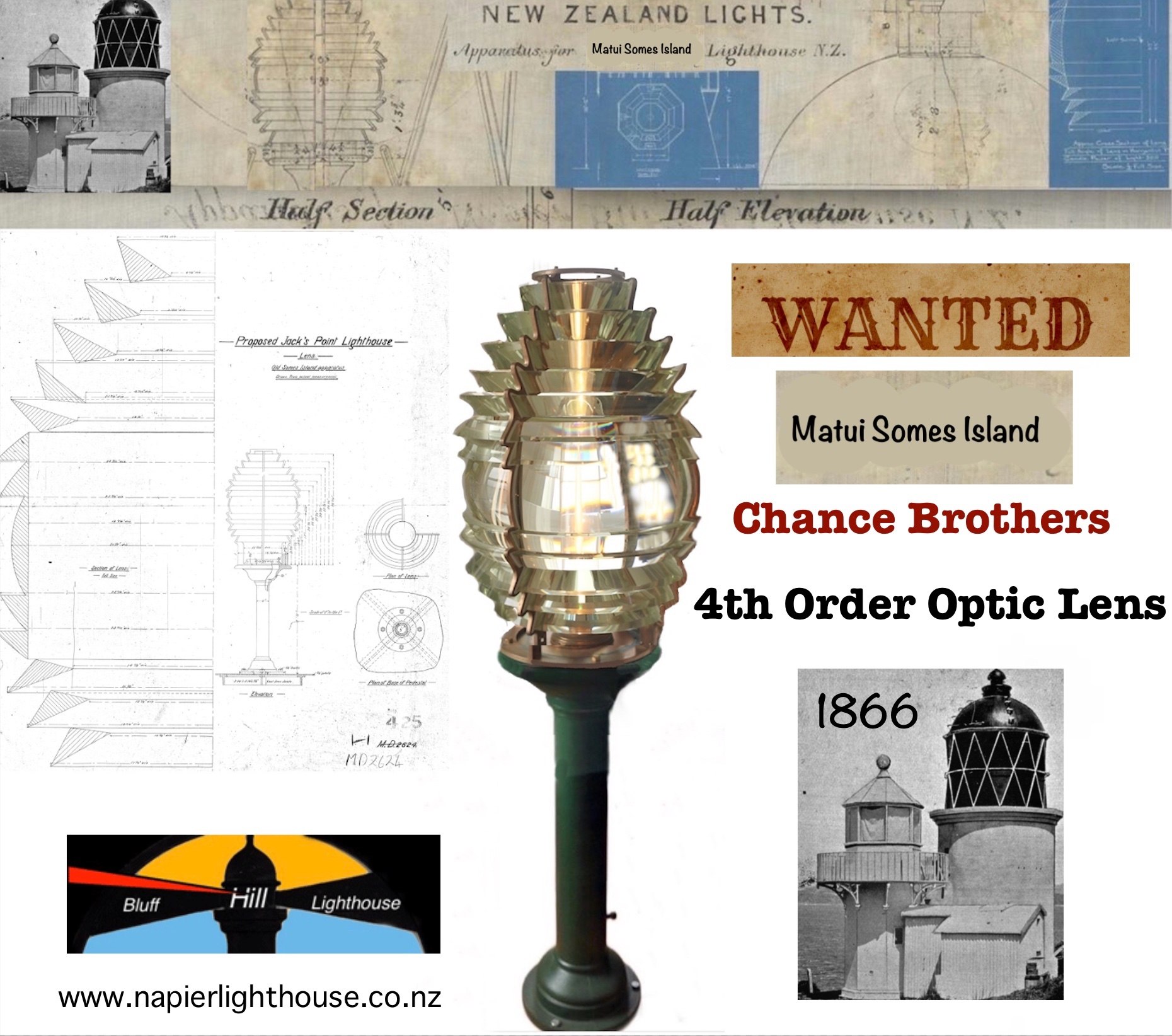
The focal point of my investigation is the 1866 Somes Island 4th-order lens. As New Zealand’s first harbour light, situated in the heart of Wellington Harbour, it is a national treasure of immense colonial and engineering significance. This Chance Brothers masterpiece—a 270-degree optic valued today at approximately $300,000 USD—was relocated to Timaru’s Jack’s Point in 1903. Despite its historical weight, neither Maritime New Zealand nor local authorities have any record of when this lens was decommissioned or where it ended up. It remains the most significant "cold case" in our maritime history.
This disappearance is not an isolated incident. My research identifies several other confirmed losses that have been "normalised" by time. The Napier Bluff Hill 4th-order lens, featuring a unique 180-degree copper reflector, went missing around 1949. Similarly, the Hokitika 5th-order lens with its glass reflector has been confirmed lost by local researchers. I am currently tracing the provenance of optics from New Plymouth, Gisborne, Tory Channel, Karori Rock, and Tuahine Point, alongside 6th-order lenses from Westport, Greymouth, Whanganui, Foxton, Waitara, and Patea.
One can only assume these lenses were taken by individuals following World War II or during the automation era. Perhaps they didn't simply vanish; perhaps these missing optics grew wings and flew back home to Birmingham after the lights went dark. While many people accept such losses as inevitable, I believe it is crucial to acknowledge and discuss this heritage. To write a history of lighthouses without acknowledging the "eye" of the tower is to tell only half the story. To me, a port town without its original light is like a man without a hat; there is a fundamental piece of the identity missing.
My objective is to document the surviving lenses through high-quality photography for a forthcoming book and use original technical drawings provided by Maritime New Zealand to reconstruct the history of those that are gone. These lenses are more than functional tools; they are "Optic Art"—the pinnacle of 19th-century engineering. Through my research, I have gained a deep understanding of Fresnel manufacture and their global value, and I am convinced these lost treasures can still be recovered.
I am currently in regular contact with Chance Brothers representatives in Australia and the USA, the US Coastguard, as well as The China Maritime Safety Administration (China MSA or CMSA) because I have a strong hunch that many of these missing lenses ended up overseas. My goal is to locate these artefacts and, where possible, facilitate their return to New Zealand through market-value purchase or fundraising via platforms like Givealittle. Recovering a lens like the Somes Island optic would not only restore a link to our maritime past but could serve as a centerpiece for a replica lighthouse in Napier, helping to save the Heritage I Prison at Coote Road.
Asking what happened to these 51 artefacts is the obvious thing to do. We are talking about engineering accomplishments that, to recreate in acrylic today, would cost upwards of $70,000. By refusing to let these "lost lights" be forgotten, I hold onto the hope that they are still out there, waiting to be brought home.
The lost Somes Island Wellington Optic Lens: NZ first Harbour light
 The Lyttelton Lighthouse Lens, 360 degree 4th order Fresnel Lens. Picture taken July 2023.
  360 degree optic lens in Lyttelton Port. The most valuable optic lens in New Zealand in my view, still in that same lighthouse today
 The Nelson Boulder Bank Lighthouse 180 degree 4th order Fresnel Lens (photo credit: Nelson Port)
 Nugget Point lighthouse 1st order Fresnel lens
 Dog Island lighthouse 2nd order Fresnel Lens (Photo credit: Plimmer’s Ark Gallery, Museum of Wellington City and Sea.)
 Lighthouse lens from Bean Rock lighthouse, 5th order lens by Chance Brothers 1878 Photo credit: Maritime Museum
  Same lens, different angle Photo credit: Maritime Museum Auckland
 5th order lens Chance Brothers Ponui Passage Photo credit: Maritime Museum Auckland
 Karori Rock Lighthouse & Tuahine Point Lighthouse 2x 4th or 5th order lenses! No trace of these lenses or pictures……..yet:-)
 Kahurangi 4th order Photo/video credit: Ashton McGill Maritime NZ https://www.youtube.com/watch?v=2-xKvRnMv-s
 Manukau Head Lighthouse lens 3rd order Photo credit: Bruce Russell Manuka Head Lighthouse
 This lens is apparently the second one that was formerly installed at the Buller region's Cape Foulwind lighthouse.
 Centre Island 1st order optic lens in the Bluff Maritime Museum Photo credit: Maritime Museum Bluff
 Cape Saunders 1865 Industrial Exhibition Dunedin
  This looks somewhat patched up with this lens? I wonder what happened to the 1865 lens at Saunders lighthouse?
 New concrete lighthouse tower behind the old demolished tower
 Taiaroa Head lighthouse lens 3rd order lens
"This Whanganui River navigation lamp is the only complete surviving light, used in Whanganui, in existence. The body is made of copper and the lens and lens shield is made of glass. This lamp is one of about twenty navigation lights that marked the main shipping channel between the Whanganui River mouth and the Whanganui Town Wharf, several kilometres upstream. The Town Wharf was in use, although on a reduced scale, as late as 1955. By 1911, however, the main shipping focus had begun to shift to Castlecliff Harbour at the mouth of the river. The channel markers stood on a tripod of hardwood pikes driven into the riverbed, on shore-based towers along the banks of the river, or on jetties such as the now derelict Imlay and Gasworks wharves. The rock walls and wooden groynes built to maintain a deep channel can still be seen at low tide and can be a hidden danger to unwary boaters. The lights were removed in the mid-1950s when, through the closure of the Town Wharf, shipping no longer travelled upstream. Edmundsons Ltd, the makers who were based in Dublin, made many of the pilot lights, beacons and lighthouses installed in New Zealand."
The lens on the left is in the Dublin museum. "1844 - apprentice to his brother-in-law Joshua Edmundson's business in Capel Street in Dublin and ran the business from 1848; interested in developing lights for lighthouses and supplying power to light them; 1877 - invented 31-day oil lamp fitted in a buoy or mounted on a tower."
https://www.greatlighttq.org/app/uploads/2018/03/Wigham-John-R-Inventor-KL-History.pdf
The picture on the centre is the same lens in the Whanganui museum. The lens on the right now belongs to the Grand Design Lighthouse couple. I am aware that there are a few optics still out there in NZ that have ended up in private hands (at least this Whanganui lens ended up in some kind of private lighthouse dream, fair enough I had that dream myself a few years ago so I understand and support that). However I suggest an amnesty from MNZ to get similar sort of Maritime history objects back into MNZ hands. A NZ Fresnel amnesty could uncover a few more lost lenses in NZ if we try, we just got to ask back for them at least for the sake of our Maritime heritage.
 Mount Egmont 2nd order optic lens. Mount Egmont Lighthouse tour: Credit Ashton McGill
https://www.youtube.com/watch?v=Ah_JbpsSMAU&list=PL2CpBHH7q6j8_EErrUpfUJV_e7LbXbBMA&index=4
 Akaroa Lighthouse 2nd order optic lens Akaroa postcard. The back reads. "The Akaroa Lighthouse at night and detail of the interior showing the original kerosene light unit with hand ground Fresnel lens made in France 1878 and the driving mechanism made in Edinburgh in the same year. The light was first lit in January 1880


 Pouto 2nd order lens (now in the Dargaville museum). Photo credit: Dargaville Museum Research
 Pouto Point with 2nd order dome removed and replaced with the 5th order Hokitika dome? Why? That looks ridiculous and made a mess of a nice lighthouse! That dome matches the original Napier Dome as well.
 French Pass Lighthouse optic 5th order but photo below is something else. I am still waiting for confirmation of what type and age this lens is and when it was put there.
 French Pass Lighthouse tour, credit Ashton McGill https://www.youtube.com/watch?v=oUnwrZlV9oY&list=PL2CpBHH7q6j8_EErrUpfUJV_e7LbXbBMA&index=5
Picture: Ashton McGill MNZ
 Farewell Spit Lighthouse 2nd order optic lens?
 Portland Island Lighthouse, now in Wairoa. 2nd order Optic lens
 Moeraki Katiki Point Lighthouse 3rd order Optic lens
 Baring Head Lighthouse 3rd order Optic lens
 Cape Palliser Lighthouse 2nd order Optic lens
 Castle Point Lighthouse 2nd order lens (Video: Ashton McGill) https://www.youtube.com/watch?v=k_TniaSxp5M
 Matiu - Somes Island lighthouse 2nd order Optic Lens in second tower
 Mokohinau Island lighthouse 1st order Optic lens 1883 (Disassembled in storage at Auckland Maritime museum) All upper & lower reflectors, middle reflectors and metal components.
 Puysegur Point 1st order Optic lens: https://www.stuff.co.nz/southland-times/news/features/96285536/what-the-demented-arsonist-did
 Tiritiri Lighthouse 1st order Fresnel Lens Photo: Anne Rimmer https://www.maritimenz.govt.nz/media/wf2nbqav/tiritiri_matangi_150th_anniversary_of_lighthouse.pdf 1865 optic, Disassembled in storage at Maritime museum
 Gisbourne 1964 so there is bigger more modern optic lens on that wharf but where is the original old school 5th order Fresnel lens I wonder? Has anybody got information about this missing Gisborne Maritime Heritage?
 Taiaroa Head Lighthouse 3rd order Optic lens Photo below: Izumi Schmidt Uchida
 Godley Head 2nd order Optic (Photos: Christchurch Star) All upper and lower reflectors and middle refractors & metal base in Maritime museum
 Vandalism! This intentionally damage to heritage should be punished with jail time!
 Stephens Island 1st order Optic lens
 Timaru Jack's Point, 4th order Optic lens, this is the only MNZ lens, nobody knows anything about. I can’t even establish when this optic was removed from that tower.
 Pencarrow Head 2nd order optic
 Brothers Island Lighthouse 2nd order lens, some parts of the lens located in Picton museum
 Timaru 5th order 180 degree lens (Messrs Barbier & Fenestre Fresnel Lens)
  Original Cape Wanbrow 5th order lens still in Oamaru
 Cape Wanbrow Oamaru
 East Cape Lighthouse 2nd order lens Picture Credit: Ashton McGill MNZ
 Picture Credit: Ashton McGill MNZ
 Cape Maria van Diemen Lighthouse 1st order lens (photo credit: Auckland Museum)
 Hi there,
I’ve searched our database and other sources but couldn’t find any information about the lens / lantern/pilot light. However there is a reference to it in this 2012 Marlborough Express article:
https://www.stuff.co.nz/marlborough-express/news/community-papers/6965548/Pilots-House-light-to-glow-stronger
I suggest you get in touch with the Havelock Museum to see if the light has been returned to them since this article was written or whether it is still on display in the old Pilot House. I also enclose an excerpt from a book that mentions the Pilot House in case it is of interest.
Good luck with your research,
Kind regards,
Wendy Harnett
Archivist
Marlborough Museum & Archives
Brayshaw Heritage Park
26 Arthur Baker Place
BLENHEIM 7201
Tel (03) 578 1712 / 021 1905627
www.marlboroughmuseum.org.nz Facebook.com/marlboroughmuseum
More smaller Lenses by the Wairau bar, this optic was gifted to the old pilot house. Wairau River 5th order lens, located in the old pilot house by the Wairau River. Best place for it! What an amazing lens!

Over the past 150 years, New Zealand’s maritime heritage has suffered a quiet but significant depletion. My research into the 51 Fresnel optics once managed by the Marine Department reveals a history defined by improvisation and eventual disappearance. In the later years of manual operation, the department was forced to manage these sophisticated optics on a shoestring budget without trained lighthouse engineers. Consequently, a culture of "swapping" parts, domes, and lenses across the network became common practice. This logistical shuffling, combined with the relocation of towers and the automation of the 1980s, created a vacuum in which some of our most valuable historic artefacts simply vanished.
The focal point of my investigation is the 1866 Somes Island 4th-order lens. As New Zealand’s first harbour light, situated in the heart of Wellington Harbour, it is a national treasure of immense colonial and engineering significance. This Chance Brothers masterpiece—a 270-degree optic valued today at approximately $300,000 USD—was relocated to Timaru’s Jack’s Point in 1903. Despite its historical weight, neither Maritime New Zealand nor local authorities have any record of when this lens was decommissioned or where it ended up. It remains the most significant "cold case" in our maritime history.
This disappearance is not an isolated incident. My research identifies several other confirmed losses that have been "normalised" by time. The Napier Bluff Hill 4th-order lens, featuring a unique 180-degree copper reflector, went missing around 1949. Similarly, the Hokitika 5th-order lens with its glass reflector has been confirmed lost by local researchers. I am currently tracing the provenance of optics from New Plymouth, Gisborne, Tory Channel, Karori Rock, and Tuahine Point, alongside 6th-order lenses from Westport, Greymouth, Whanganui, Foxton, Waitara, and Patea.
One can only assume these lenses were taken by individuals following World War II or during the automation era. Perhaps they didn't simply vanish; perhaps these missing optics grew wings and flew back home to Birmingham after the lights went dark. While many people accept such losses as inevitable, I believe it is crucial to acknowledge and discuss this heritage. To write a history of lighthouses without acknowledging the "eye" of the tower is to tell only half the story. To me, a port town without its original light is like a man without a hat; there is a fundamental piece of the identity missing.
My objective is to document the surviving lenses through high-quality photography for a forthcoming book and use original technical drawings provided by Maritime New Zealand to reconstruct the history of those that are gone. These lenses are more than functional tools; they are "Optic Art"—the pinnacle of 19th-century engineering. Through my research, I have gained a deep understanding of Fresnel manufacture and their global value, and I am convinced these lost treasures can still be recovered.
I am currently in regular contact with Chance Brothers representatives in Australia and the USA, the US Coastguard, as well as The China Maritime Safety Administration (China MSA or CMSA) because I have a strong hunch that many of these missing lenses ended up overseas. My goal is to locate these artefacts and, where possible, facilitate their return to New Zealand through market-value purchase or fundraising via platforms like Givealittle. Recovering a lens like the Somes Island optic would not only restore a link to our maritime past but could serve as a centerpiece for a replica lighthouse in Napier, helping to save the Heritage I Prison at Coote Road.
Asking what happened to these 51 artefacts is the obvious thing to do. We are talking about engineering accomplishments that, to recreate in acrylic today, would cost upwards of $70,000. By refusing to let these "lost lights" be forgotten, I hold onto the hope that they are still out there, waiting to be brought home.
The lost Somes Island Wellington Optic Lens: NZ first Harbour light
 The Lyttelton Lighthouse Lens, 360 degree 4th order Fresnel Lens. Picture taken July 2023. 360 degree optic lens in Lyttelton Port. The most valuable optic lens in New Zealand in my view, still in that same lighthouse todayThe Nelson Boulder Bank Lighthouse 180 degree 4th order Fresnel Lens (photo credit: Nelson Port)Nugget Point lighthouse 1st order Fresnel lensDog Island lighthouse 2nd order Fresnel Lens (Photo credit: Plimmer’s Ark Gallery, Museum of Wellington City and Sea.)Lighthouse lens from Bean Rock lighthouse, 5th order lens by Chance Brothers 1878 Photo credit: Maritime Museum Same lens, different angle Photo credit: Maritime Museum Auckland5th order lens Chance Brothers Ponui Passage Photo credit: Maritime Museum AucklandKarori Rock Lighthouse & Tuahine Point Lighthouse 2x 4th or 5th order lenses! No trace of these lenses or pictures……..yet:-)Kahurangi 4th order Photo/video credit: Ashton McGill Maritime NZ https://www.youtube.com/watch?v=2-xKvRnMv-sManukau Head Lighthouse lens 3rd order Photo credit: Bruce Russell Manuka Head LighthouseThis lens is apparently the second one that was formerly installed at the Buller region's Cape Foulwind lighthouse.Centre Island 1st order optic lens in the Bluff Maritime Museum Photo credit: Maritime Museum BluffCape Saunders 1865 Industrial Exhibition Dunedin This looks somewhat patched up with this lens? I wonder what happened to the 1865 lens at Saunders lighthouse?New concrete lighthouse tower behind the old demolished towerTaiaroa Head lighthouse lens 3rd order lens
"This Whanganui River navigation lamp is the only complete surviving light, used in Whanganui, in existence. The body is made of copper and the lens and lens shield is made of glass. This lamp is one of about twenty navigation lights that marked the main shipping channel between the Whanganui River mouth and the Whanganui Town Wharf, several kilometres upstream. The Town Wharf was in use, although on a reduced scale, as late as 1955. By 1911, however, the main shipping focus had begun to shift to Castlecliff Harbour at the mouth of the river. The channel markers stood on a tripod of hardwood pikes driven into the riverbed, on shore-based towers along the banks of the river, or on jetties such as the now derelict Imlay and Gasworks wharves. The rock walls and wooden groynes built to maintain a deep channel can still be seen at low tide and can be a hidden danger to unwary boaters. The lights were removed in the mid-1950s when, through the closure of the Town Wharf, shipping no longer travelled upstream. Edmundsons Ltd, the makers who were based in Dublin, made many of the pilot lights, beacons and lighthouses installed in New Zealand."
The lens on the left is in the Dublin museum. "1844 - apprentice to his brother-in-law Joshua Edmundson's business in Capel Street in Dublin and ran the business from 1848; interested in developing lights for lighthouses and supplying power to light them; 1877 - invented 31-day oil lamp fitted in a buoy or mounted on a tower."
https://www.greatlighttq.org/app/uploads/2018/03/Wigham-John-R-Inventor-KL-History.pdf
The picture on the centre is the same lens in the Whanganui museum. The lens on the right now belongs to the Grand Design Lighthouse couple. I am aware that there are a few optics still out there in NZ that have ended up in private hands (at least this Whanganui lens ended up in some kind of private lighthouse dream, fair enough I had that dream myself a few years ago so I understand and support that). However I suggest an amnesty from MNZ to get similar sort of Maritime history objects back into MNZ hands. A NZ Fresnel amnesty could uncover a few more lost lenses in NZ if we try, we just got to ask back for them at least for the sake of our Maritime heritage.
Mount Egmont 2nd order optic lens. Mount Egmont Lighthouse tour: Credit Ashton McGillhttps://www.youtube.com/watch?v=Ah_JbpsSMAU&list=PL2CpBHH7q6j8_EErrUpfUJV_e7LbXbBMA&index=4
Akaroa Lighthouse 2nd order optic lens Akaroa postcard. The back reads. "The Akaroa Lighthouse at night and detail of the interior showing the original kerosene light unit with hand ground Fresnel lens made in France 1878 and the driving mechanism made in Edinburgh in the same year. The light was first lit in January 1880Pouto 2nd order lens (now in the Dargaville museum). Photo credit: Dargaville Museum ResearchPouto Point with 2nd order dome removed and replaced with the 5th order Hokitika dome? Why? That looks ridiculous and made a mess of a nice lighthouse! That dome matches the original Napier Dome as well.French Pass Lighthouse optic 5th order but photo below is something else. I am still waiting for confirmation of what type and age this lens is and when it was put there. French Pass Lighthouse tour, credit Ashton McGill https://www.youtube.com/watch?v=oUnwrZlV9oY&list=PL2CpBHH7q6j8_EErrUpfUJV_e7LbXbBMA&index=5Picture: Ashton McGill MNZ
Farewell Spit Lighthouse 2nd order optic lens?Portland Island Lighthouse, now in Wairoa. 2nd order Optic lensMoeraki Katiki Point Lighthouse 3rd order Optic lensBaring Head Lighthouse 3rd order Optic lensCape Palliser Lighthouse 2nd order Optic lensCastle Point Lighthouse 2nd order lens (Video: Ashton McGill) https://www.youtube.com/watch?v=k_TniaSxp5MMatiu - Somes Island lighthouse 2nd order Optic Lens in second towerMokohinau Island lighthouse 1st order Optic lens 1883 (Disassembled in storage at Auckland Maritime museum) All upper & lower reflectors, middle reflectors and metal components. Puysegur Point 1st order Optic lens: https://www.stuff.co.nz/southland-times/news/features/96285536/what-the-demented-arsonist-didTiritiri Lighthouse 1st order Fresnel Lens Photo: Anne Rimmer https://www.maritimenz.govt.nz/media/wf2nbqav/tiritiri_matangi_150th_anniversary_of_lighthouse.pdf 1865 optic, Disassembled in storage at Maritime museumGisbourne 1964 so there is bigger more modern optic lens on that wharf but where is the original old school 5th order Fresnel lens I wonder? Has anybody got information about this missing Gisborne Maritime Heritage?Taiaroa Head Lighthouse 3rd order Optic lens Photo below: Izumi Schmidt UchidaGodley Head 2nd order Optic (Photos: Christchurch Star) All upper and lower reflectors and middle refractors & metal base in Maritime museumVandalism! This intentionally damage to heritage should be punished with jail time!Stephens Island 1st order Optic lensTimaru Jack's Point, 4th order Optic lens, this is the only MNZ lens, nobody knows anything about. I can’t even establish when this optic was removed from that tower.Pencarrow Head 2nd order opticBrothers Island Lighthouse 2nd order lens, some parts of the lens located in Picton museumTimaru 5th order 180 degree lens (Messrs Barbier & Fenestre Fresnel Lens) Original Cape Wanbrow 5th order lens still in OamaruCape Wanbrow OamaruEast Cape Lighthouse 2nd order lens Picture Credit: Ashton McGill MNZPicture Credit: Ashton McGill MNZCape Maria van Diemen Lighthouse 1st order lens (photo credit: Auckland Museum)Hi there,I’ve searched our database and other sources but couldn’t find any information about the lens / lantern/pilot light. However there is a reference to it in this 2012 Marlborough Express article:
https://www.stuff.co.nz/marlborough-express/news/community-papers/6965548/Pilots-House-light-to-glow-stronger
I suggest you get in touch with the Havelock Museum to see if the light has been returned to them since this article was written or whether it is still on display in the old Pilot House. I also enclose an excerpt from a book that mentions the Pilot House in case it is of interest.
Good luck with your research,
Kind regards,
Wendy Harnett
Archivist
Marlborough Museum & Archives
Brayshaw Heritage Park
26 Arthur Baker Place
BLENHEIM 7201
Tel (03) 578 1712 / 021 1905627
www.marlboroughmuseum.org.nz Facebook.com/marlboroughmuseum
More smaller Lenses by the Wairau bar, this optic was gifted to the old pilot house.
Wairau River 5th order lens, located in the old pilot house by the Wairau River. Best place for it! What an amazing lens!